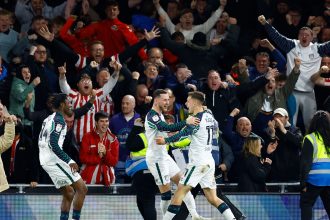
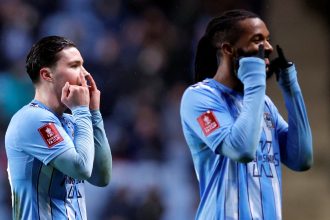
Last Saturday, as Burnley staged a minute’s applause for Ukraine, Chelsea fans chanted the name of their departing Russian owner, Roman Abramovich. For the previous 10 days, the news and social media had been flooded with images of the most horrendous suffering from Ukraine, of shattered apartment blocks, bloodied bodies and trains of refugees. But that was not enough: Their own identity mattered more than offering even a minute of empathy to a stricken nation.
This is not a complicated war. There is a clear aggressor. And yet some base instinct kicked in. The owner of Chelsea, the man who has bought them two Champions League titles, five Premier League trophies, five FA Cups and three League Cups, is a Russian oligarch. Russia is fighting Ukraine. Abramovich, at that point, was being forced to sell the club because of the threat of possible sanctions. And so Chelsea fans chanted his name over the applause.
Chelsea coach Thomas Tuchel was clearly appalled. “We take the knee together; if a person from our club dies we show respect,” he said. “It’s not a moment to give other messages. We also do this because of what we are as a club. We show respect, and we need our fans to commit to this minute of applause in the moment. We do it for the people of Ukraine, and there is no second opinion about the situation. They have our thoughts and our support and we should stand together as a club.”
It happened again Thursday. As Chelsea, mere hours after the U.K. government dropped those anticipated sanctions on Abramovich that froze his British assets and significantly altered the club’s present and future, took to the pitch against Norwich City, the traveling supporters at Carrow Road again chanted Abramovich’s name.
But that is what sportswashing does—or rather, part of what it does. It provides the owners of clubs with a willing army of advocates who will go into battle in stadiums and on social media on their behalf. It is entirely possible, of course, for Chelsea fans both to feel grateful to Abramovich and to respect the right of others to express their sympathy with Ukraine, but what transpired last weekend was not that. To chant, in that moment, the name of a prominent Russian—one who still denies close links to Vladimir Putin and insists he bought the club purely because of his love of football—was to take sides in the information war.
And that, of course, is why those who have followed Abramovich, whatever his motivation, have bought clubs. Sheikh Mansour of Abu Dhabi and the Public Investment Fund of Saudi Arabia have bought Manchester City and Newcastle United, respectively, partly to gain a foothold in the U.K. but also to massage the reputations of their states. That includes taking on a section of their fans as willing propaganda foot soldiers. You might think that fans would be outraged at their clubs being used in that way, venerable institutions become weapons in a tawdry game, but if an owner can provide the funds to sign the players who might bring success, anything goes.
Of course, fans are placed in an invidious position. Newcastle fans went through long years of frustration under Mike Ashley. If they are excited by the prospect of better players and better football, by a club playing with optimism rather than simply continuing to exist in the Premier League, they can hardly be blamed. Yet in the rush to lionize fans over the past two decades, in the widespread celebration of their “faith” and “suffering,” something has become addled—not least the fact that not winning the league for a few years, even getting relegated repeatedly, is not actually suffering. It is now as though, among some fans, there is an entitlement to success, or at least excitement. And that leads some, a small but vocal minority, to attack journalists who point to human rights abuses in the states that now run clubs, who ask what their motives may be, who feel uncomfortable at the use of an English football club to deflect from atrocity; and, worse, to attack Hanan Elatr, the widow of Jamal Khashoggi, for daring to protest that the Saudi state had murdered her husband.
It is a very strange mindset. They point out that these states invest in other companies, many of which are widely used. They point out that the British government supplies weapons to Saudi Arabia and ask why they should be held to a higher standard. They point out that a lot of the hedge funds that own clubs aren’t exactly saints. And all these things are true. But the point is that we should be protesting about them as well. Just because some things are bad doesn’t mean we should wave through all bad things.
If, as we are constantly told and as is surely true, a football club is not a normal business, if the bond between a fan and its club is sacred, why would you want to hand it over to distant owners whose record of treating people with dignity and respect is so questionable, who do not love it as you do? And who might suddenly decide to stop funding the club—or worse, be forced to stop funding it? But once the lie has been swallowed, human nature seems to be not to admit it, but to keep making excuses, to keep engaging in whataboutery, to keep attacking critics, to keep trying to justify it rather than accept the truth.
Complicating the issue is the nature of much modern media. When journalists are judged on clicks, and when the social media outcry against those perceived to have somehow stepped out of line can be so vociferous, some inevitably fall to the temptation to tell their immediate audience what they want to hear and pander to tribalism.
But as long as people are talking about the leaders of Saudi Arabia and Abu Dhabi as the owners of football clubs—and even if we accept the fig leaf, as the Premier League has, that Newcastle is 80% owned not by the Saudi state but by its public investment fund, whose chair is the leader of Saudi Arabia, Mohammed bin Salman—they are not talking about human rights abuses or the bombing of Yemen. They are creating an alternative narrative. That is sportswashing.